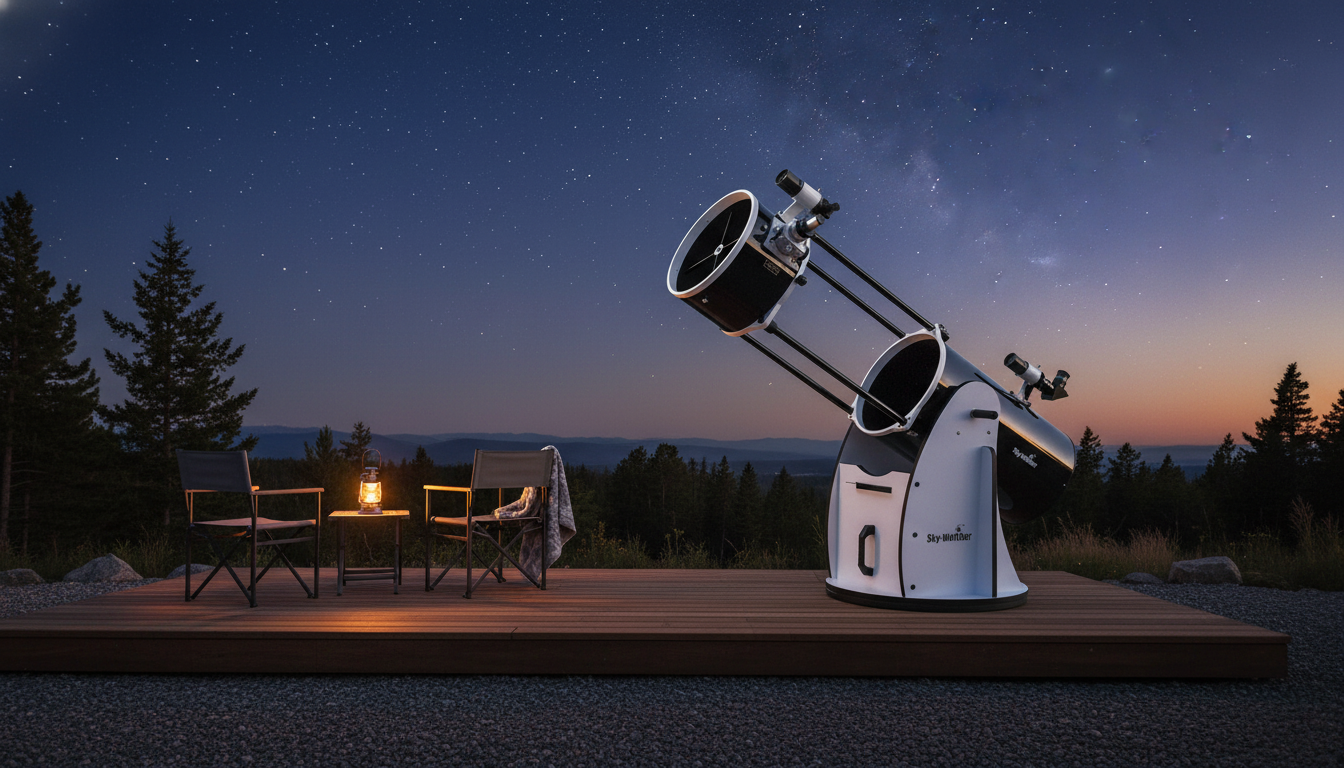
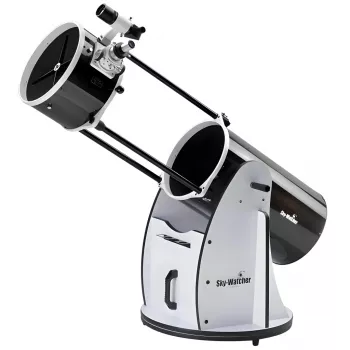
A 10-inch collapsible Dobsonian pairs serious light-gathering power with a design that shrinks down for transport and storage. The result is a telescope that feels “big” at the eyepiece—bright nebulae, more galaxy detail, and stronger planetary potential—while being easier to live with in closets, trunks, and smaller homes than a full-length solid tube. Below is what to expect from the format, how collapsible construction changes setup and care, and how to get consistently sharp views of the Moon, planets, and deep-sky objects.
A Dobsonian mount is popular for a reason: it’s stable, intuitive, and efficient. Instead of wrestling with complicated controls, you simply point, nudge, and track objects by hand—an approach that makes casual weeknight observing feel approachable and keeps the focus on what’s in the eyepiece.
For a practical option that balances aperture with a compact footprint, see the 10″ Collapsible Dobsonian Telescope.
“10-inch” refers to the primary mirror diameter (254 mm). That surface area is what gathers light, and it’s the reason a 10-inch Dobsonian can make dim objects feel more “present”—globular clusters show more individual stars, bright nebulae reveal more structure, and galaxies gain definition under darker skies.
| Aperture | What improves most | Common portability note |
|---|---|---|
| 8-inch | Easy deep-sky entry, solid planetary detail | Often simplest one-person carry |
| 10-inch | Noticeably brighter deep-sky, stronger resolution potential | Heavier base; tube length reduced on collapsible designs |
| 12-inch | Biggest jump on faint objects under dark skies | Bulky; storage and transport planning required |
A collapsible Dobsonian is built to shrink for storage, but that convenience comes with a few ownership habits that help keep performance consistent.
For deeper background on alignment tools and technique, Sky & Telescope’s collimation resources are a solid starting point: https://skyandtelescope.org/astronomy-resources/.
Small steps make a big difference with a 10-inch mirror—especially on nights when you want crisp lunar and planetary detail.
Sky quality is the multiplier. The International Dark-Sky Association offers a helpful overview of why brighter skies wash out faint detail: https://darksky.org/light-pollution/. And if you’re introducing space-distance concepts to newer observers, NASA’s simple explanation of a light-year is worth bookmarking: https://spaceplace.nasa.gov/light-year/en/.
If you also like capturing simple night-sky time-lapses or phone-based sky shots alongside your visual observing, a sturdy travel support can help; consider the Carbon Fiber Travel Tripod with Teleprompter Mount for lightweight transport.
| Step | Purpose |
|---|---|
| Cap optics and secure accessories | Prevents dust and damage |
| Lock/strap moving parts | Stops shifting during transit |
| Bring collimation tool | Ensures alignment at the site |
| Pack dew control or shroud | Maintains contrast and comfort |
| Feature | Why it matters |
|---|---|
| 10-inch aperture | Brighter deep-sky views and higher resolution potential |
| Collapsible tube | Reduced storage/transport size |
| Dobsonian base | Simple pointing and stable viewing |
Product page: 10″ Collapsible Dobsonian Telescope.
It’s wise to check collimation before higher-magnification sessions, since collapsing and transport can introduce small alignment shifts. The good news is that once the routine is familiar, a quick check typically takes only a minute or two.
Many people handle a 10-inch Dobsonian solo by carrying the base and tube separately. The collapsible tube helps reduce awkward length, but the base can still be substantial—stairs, vehicle fit, and lifting comfort are the key deciding factors.
Observing from darker skies (when possible) makes the most immediate difference, especially on galaxies and nebulae. After that, accurate collimation plus adequate cooldown time often delivers a noticeable jump in sharpness, and a low-power wide-field eyepiece makes finding targets far easier.





Leave a comment