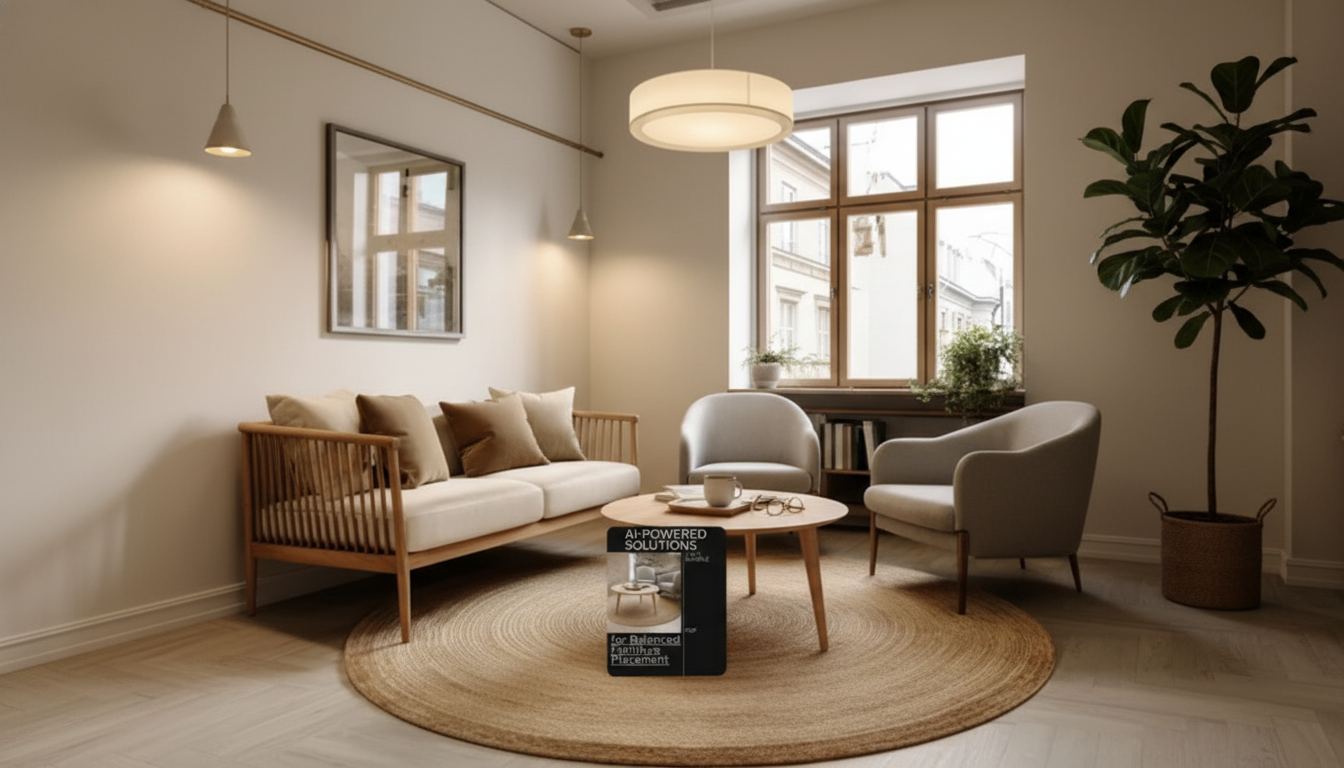
Balanced furniture placement blends comfort, clear pathways, and visual harmony—without endless trial-and-error. A practical way to get there is to combine a simple layout workflow (measure, map, place, refine) with fast AI-assisted iteration and a checklist that catches the “small” mistakes that become daily annoyances. The AI-Powered Solutions for Balanced Furniture Placement | 3-in-1 Bundle of Guides, eBooks, and Checklists was built for exactly that: rooms that feel open, functional, and calm, even with awkward dimensions or mixed-use needs.
Balance isn’t about symmetry or matching sets. It’s about a room that works the moment you walk in—and keeps working when real life happens.
AI works best as a rapid layout generator and “constraint checker,” not as the final decision-maker for how a household lives. When room dimensions and furniture measurements are accurate, AI can quickly reveal options that might not be obvious on the first pass.
For safety and comfort baselines—especially for pathways and exits—authoritative references like the 2010 ADA Standards for Accessible Design and the NFPA 101: Life Safety Code offer helpful principles to keep in mind (even for non-commercial spaces).
The value of a bundle is repeatability: the same process can be used for a living room refresh, a tricky open-plan zone, or a bedroom that needs better flow around the bed.
For an additional design perspective focused on calm, clutter resistance, and balanced flow, pair the bundle with Mastering Furniture Arrangement for Calm and Clarity | Home Design Guide for Minimalist Interiors, Feng Shui Energy Flow, and Balanced Room Layouts.
| Area | Practical target | Why it helps |
|---|---|---|
| Main walkways | Keep pathways comfortably passable | Reduces bottlenecks and makes the room feel larger |
| Door swings & drawers | Allow full open/close without collision | Prevents daily frustration and damage |
| Seating groups | Arrange for easy conversation and reach to surfaces | Improves comfort and usability |
| TV viewing | Position seating to reduce glare and extreme neck angles | Supports longer, more comfortable viewing |
| Work zones | Keep chair movement and access unobstructed | Improves focus and reduces clutter creep |
Professional design organizations like the American Society of Interior Designers (ASID) emphasize functionality and human-centered planning—exactly the mindset that makes AI output more useful when paired with real-life priorities.
If the goal is a repeatable system that works across rooms, the AI-Powered Solutions for Balanced Furniture Placement | 3-in-1 Bundle of Guides, eBooks, and Checklists combines learning (guides/eBooks) with execution (checklists). It supports both quick refreshes (one afternoon) and deeper re-thinks (weekend projects) while reducing common missteps like overcrowding, blocked access, and layouts that look fine but feel uncomfortable in daily use.
Use precise room dimensions, door/window locations, and the exact measurements of each furniture piece. Include non-negotiables like TV placement, seating count, workstation needs, and anything that can’t be moved (radiators, built-ins, outlets you rely on).
Yes—AI is especially helpful for producing multiple zoning ideas and circulation paths quickly. Validate the final option with a walk-through test and clearance checks so the layout works at real-life speed, not just on a diagram.
Check the room from key viewpoints, especially the entry and the main seating position. Distribute tall/heavy items across the visual field, avoid clustering big pieces on one side, and make sure the focal point and zones read clearly.






Leave a comment