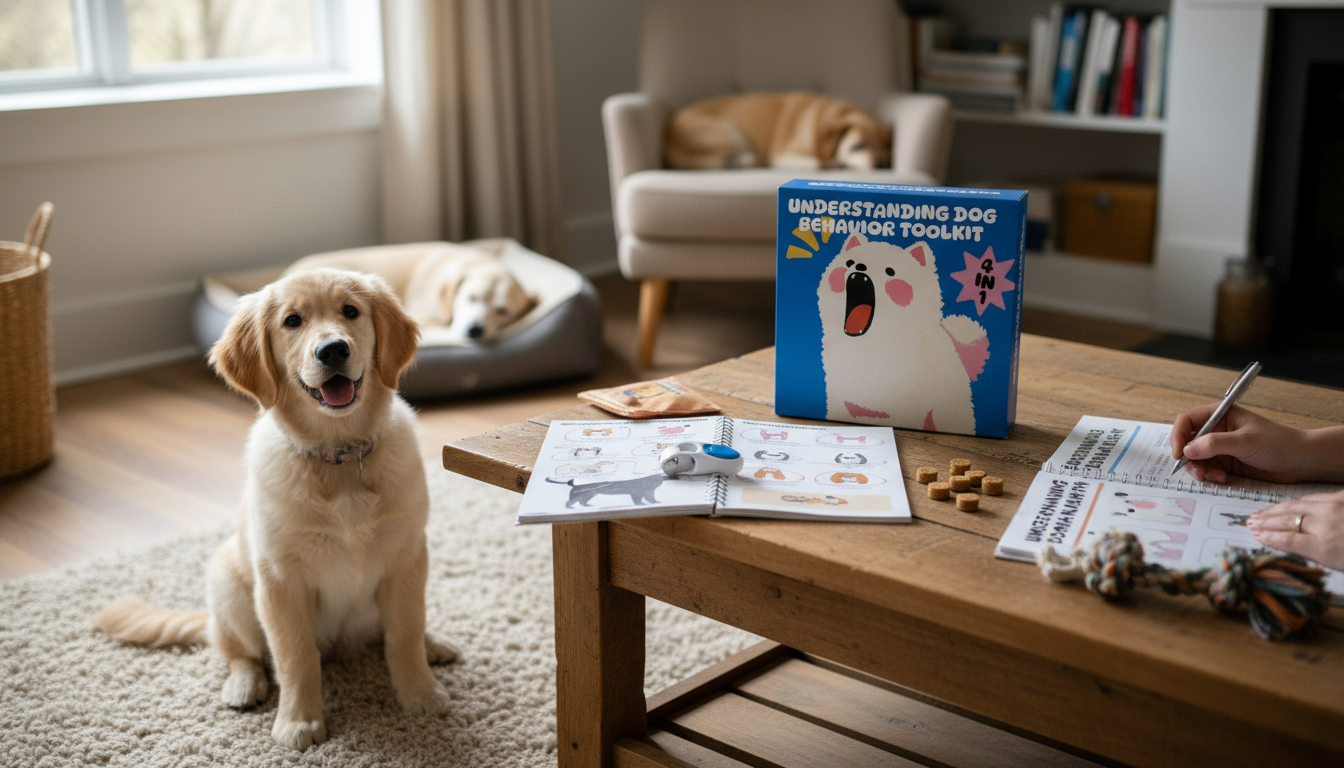
Dog behavior is rarely “random.” What looks like stubbornness is often a predictable result of stress levels, environment, reinforcement history, and how clearly (or confusingly) humans respond. A well-built behavior toolkit turns day-to-day moments—walks, greetings, noise triggers, alone-time—into a system you can observe, measure, and improve. The goal isn’t perfect obedience; it’s calmer routines, safer choices, and a dog that understands how to succeed.
A structured bundle works best when it removes guesswork and gives the household shared definitions, shared steps, and shared expectations. A 4-in-1 format is especially useful when it combines reading the dog, setting up the environment, and training skills that hold up in real life.
For a consolidated starting point, explore the Understanding Dog Behavior Toolkit – 4-in-1 Bundle.
Dogs don’t read rulebooks—people create patterns. Toolkits are most effective for owners who want structure and consistency, particularly during transitions or when multiple factors are feeding into the same unwanted habit.
Reliable behavior change comes from understanding what maintains the behavior—not from escalating intensity. Evidence-based, welfare-forward education typically includes a few foundational concepts.
For deeper context on humane, science-based approaches, see the American Veterinary Society of Animal Behavior (AVSAB) position statements and the RSPCA overview on understanding dog behaviour.
Weekly planning keeps training from turning into “trial and error.” It also helps prevent the common trap of changing five things at once—then not knowing what actually worked.
| Day | Focus | What to Track |
|---|---|---|
| 1 | Baseline observations and trigger list | Time, location, trigger, intensity (1–5) |
| 2 | Management changes | How often the behavior was prevented |
| 3 | Teach replacement behavior indoors | Success rate out of 10 reps |
| 4 | Add mild distractions | Latency to respond (seconds) |
| 5 | Practice in a new room/yard | Consistency across locations |
| 6 | Real-life setups (controlled) | Distance to trigger; recovery time |
| 7 | Review and adjust next week’s plan | Wins, sticking points, next steps |
Starting points should be safe, repeatable, and easy to measure. If a plan can’t be practiced calmly, it’s usually too hard for that week.
For additional training and handling guidance across life stages, the AKC training and behavior resources can be a helpful reference alongside a structured plan.
Timelines depend on the behavior, the dog’s history, and consistency, but many owners notice early changes within 1–3 weeks when they practice daily and track progress. Reactivity and fear-based behaviors often take longer and improve most with gradual, structured steps.
A toolkit can provide strong foundations and make training more consistent day to day. For aggression, biting, severe anxiety, or when progress stalls despite careful implementation, working with a qualified professional is the safer option.
Start by identifying the dog’s threshold distance and immediately increasing space to prevent blowups. Then reinforce calm disengagement and focus in low-distraction settings before practicing around triggers with carefully controlled distance.






Leave a comment