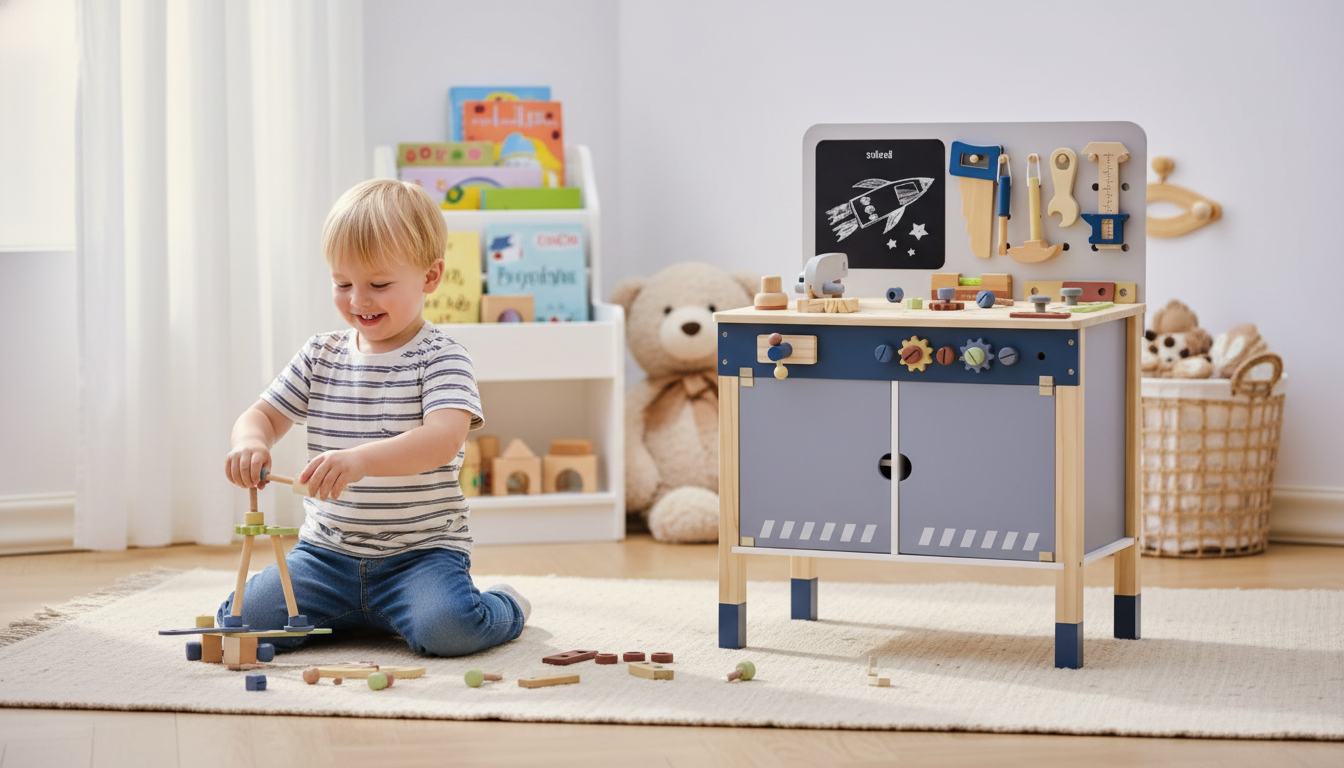
A wooden workbench playset turns pretend fixing and building into a screen-free activity that supports early problem-solving, coordination, and confidence. With a kid-sized bench, tools, and fasteners, children get a “real job” space where they can tinker, sort, and create—over and over—without needing a new toy every week. This guide covers what to look for in a kids’ workbench, how to set it up for safe play, and simple activity ideas that keep kids engaged over time.
A kids’ workbench isn’t just cute pretend play—it’s an everyday station for hands-on learning and “I can do it” moments.
Not all play workbenches are built the same. A few practical details can make the difference between a toy that gets daily use and one that wobbles into the closet.
For general toy safety basics and age-appropriate guidance, review the U.S. Consumer Product Safety Commission’s Toy Safety resources and the American Academy of Pediatrics’ toy safety guidance.
Use this table to compare workbenches quickly before buying or gifting. Prioritize safety and sturdiness first, then choose the tool/part mix based on the child’s interests (building vs. fixing vs. sorting).
| What to Check | Why It Matters | What to Look For |
|---|---|---|
| Stability | Prevents tipping and frustration | Wide base, balanced design, minimal wobble |
| Finish quality | Reduces snags and rough edges | Smooth wood, rounded corners, clean joins |
| Tool variety | Keeps play fresh and skill-based | Multiple tools and interactive parts |
| Piece size | Supports safe, age-appropriate play | Grippable parts; avoid very tiny pieces for younger kids |
| Storage | Encourages independent cleanup | Shelf space, hooks, bins, labeled spots |
| Ease of setup | Less hassle; safer play sooner | Clear instructions, sturdy fittings |
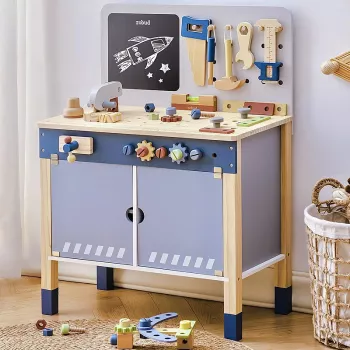
If you’re looking for a classic, tactile set that encourages repeat play, the Wooden Kids Workbench Playset with Tools offers a wooden-themed bench designed for pretend building and hands-on play.
To make the workbench area easier to live with day-to-day, consider pairing it with resources that support an orderly, kid-friendly setup. For example, Mastering Furniture Arrangement for Calm and Clarity | Home Design Guide can help when you’re planning a play corner, and Calm With Smart Tools — AI-Enhanced Stress Relief Ebook can be a handy guide for building more screen-light routines at home.
A workbench should feel inviting, not overwhelming. Matching the set to your child’s stage—and setting a few simple boundaries—keeps play safer and more satisfying.
For additional context on toy safety expectations, ASTM provides an overview of the ASTM F963 toy safety standard.
Once the novelty wears off, a few repeatable “mini challenges” can make the workbench feel brand new—without buying extra pieces.
Many sets work well for preschool through early elementary ages, but the best fit depends on the specific product’s age grading and the child’s skills. Younger kids typically do better with larger, easier-to-grip pieces and close supervision.
They can be, as long as the set follows the manufacturer’s age recommendation and avoids very small parts that could pose a choking risk. Look for smooth, well-finished wood and plan on hands-on supervision during play.
Workbenches build fine-motor strength and hand-eye coordination while kids practice sequencing steps, testing ideas, and solving small problems. They also encourage language (explaining what they built) and early math skills like counting, sorting, and matching.






Leave a comment