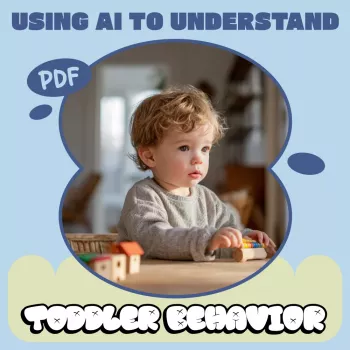
Toddler days can feel unpredictable: a peaceful morning turns into a meltdown at lunch, or bedtime becomes a battle after an otherwise “good” day. Often, the difference isn’t your child’s personality—it’s the invisible stuff (sleep timing, hunger, overstimulation, abrupt transitions) stacking up. AI can help by turning scattered notes into organized patterns: common triggers, time-of-day hotspots, repeat situations, and which calming responses tend to shorten the storm.
AI is most useful as a pattern-finder when parents enter consistent, specific observations. It can highlight what changed on tough days (short nap, missed snack, visitors, screen time, a new environment) and suggest simple routine experiments to test for a week at a time—like shifting the wind-down earlier or smoothing a rough transition.
What it can’t do: diagnose developmental conditions, evaluate medical concerns, or replace pediatricians, sleep consultants, or mental health professionals. Use it as a helper for organizing and testing hypotheses—not as a final authority.
The goal isn’t perfect tracking—it’s capturing enough signal to see patterns. Start with 3–5 areas that often drive toddler behavior:
Keep notes objective and short: what happened right before, what your toddler did, what you did, and what helped (or didn’t). Add a couple context tags like “home day,” “daycare,” “illness,” “travel,” “visitors,” or “loud environment.” Thirty to sixty seconds per entry is enough if done consistently. Pick one primary goal at a time (bedtime battles, biting, separation tears, morning routine) so the data stays focused.
| Time | Situation | What happened right before | Behavior | Adult response | Outcome (minutes) | Notes (sleep/food/changes) |
|---|---|---|---|---|---|---|
| 7:15 AM | Getting dressed | Asked to stop playing and change clothes | Cried + dropped to floor | Offered choice of two shirts; 30-sec hug | 6 | Woke 45 min earlier than usual |
| 12:40 PM | Lunch | Waiting for food to cool | Hit table; yelled | Gave small snack; named feeling; set boundary | 4 | Skipped morning snack |
| 7:50 PM | Bedtime | Lights down; said goodnight | Ran out of room; protested | Two-check method; consistent script | 18 | Nap was short; screen time after dinner |
Once a few days of notes exist, ask AI for outputs that support action rather than vague commentary. Useful weekly requests include: the top three triggers, the top three calming strategies that reduced duration, and time-of-day patterns. It also helps to separate variables—ask for one pass that looks only at sleep timing, and another that looks only at transitions or hunger.
Neutral wording improves results. Replace labels like “bad” or “defiant” with observable descriptions: “cried, threw toy, tried to run away.” Then request the “next smallest change”: one low-effort routine tweak that you can measure for seven days, plus a simple way to review whether it helped.
Many meltdowns are really transition problems. Look for “transition clusters,” where a toddler faces back-to-back demands: wake → dress → leave, or dinner → bath → bed. AI can help you map these clusters and propose a smoother flow.
Evidence-based guidance emphasizes predictable structure and positive attention for desired behaviors; for practical examples of supportive routines, see the CDC’s Positive Parenting Tips for toddlers.
Common friction points to analyze include overtired vs. undertired patterns, late naps, inconsistent wake times, and stimulating evenings. A stable wake time often improves bedtime more than constantly adjusting bedtime itself. For general sleep guidance by age and stage, the NHS toddler sleep overview is a helpful reference.
It can also help to tag “need states”: hungry, tired, overstimulated, under-stimulated, seeking connection, or seeking control. AI can then help you draft toddler-sized validation + boundary scripts, such as: “You’re mad. Hitting hurts. Hands stay safe. You can stomp or squeeze the pillow.” For more on tantrums and what’s typical, the AAP’s guidance on temper tantrums offers reassuring, practical framing.
Start with sleep timing (wake, nap, bedtime) plus one or two high-friction transitions, and keep entries short and factual. After a week, summarize the top triggers and the few responses that most reliably shortened meltdowns.
Yes—focus on a few anchors (wake time, nap timing, bedtime) and run one simple 7-day experiment at a time. Measure outcomes like time-to-sleep and night wakes rather than tracking every detail.
It can be safer when notes avoid personal identifiers, are stored securely, and are shared only with trusted caregivers. Treat AI suggestions as ideas to test, and consult professionals if serious concerns or red flags appear.






Leave a comment